.jpg)

What’s Really in Your Eggs? We Put Ours to the Test
Posted By Gautham PB on Tuesday 23rd December 2025
You may have recently come across news articles and videos discussing egg safety in India, especially around concerns of antibiotic residues and farming practices.
Nasty chemicals (nitrofuran) in eggs.
Reference:
https://www.foodtechnetwork.in/fssai-launches-nationwide-egg-safety-drive-over-antibiotic-concerns/
https://www.foodtechnetwork.in/fssai-launches-nationwide-egg-safety-drive-over-antibiotic-concerns/
We understand that this can raise questions, and we believe the best response is transparency.
So instead of opinions or assurances, A recent batch of our
free-range eggs
was tested at SGS India Pvt. Ltd., a NABL-accredited laboratory, using standard food safety testing protocols followed across India.
free-range eggs
was tested at SGS India Pvt. Ltd., a NABL-accredited laboratory, using standard food safety testing protocols followed across India.
We have shared the key takeaways of the report below for easy understanding.
Food safety discussions can sometimes get confusing, especially when social media clips lack full context. Rather than commenting on individual claims, we prefer to rely on Independent testing, Accredited laboratories and Clear, verifiable data
Hope you found the report and the below information useful.
Thank you for your continued trust.
Warm regards,
Gautham
Healthy Buddha
Independent Lab Testing of Our Eggs
Below is a simple summary of what was tested and what the results mean.
1. Antibiotics & Veterinary Drug Residues
Given the recent discussions, this is often the biggest concern.
The eggs were screened for a wide range of banned and commonly misused antibiotics, including:
Nitrofurans (AOZ, AMOZ, AHD, SEM)
Chloramphenicol
Tetracyclines
Colistin, Streptomycin, Neomycin
Growth promoters and other veterinary drugs
Result:
All substances were reported as Not Detected (ND) or Below Quantification Limit (BLQ).
What this means:
If any of these substances were present, even at trace levels, the lab equipment would have detected them. The results indicate no measurable antibiotic residue in the eggs tested.
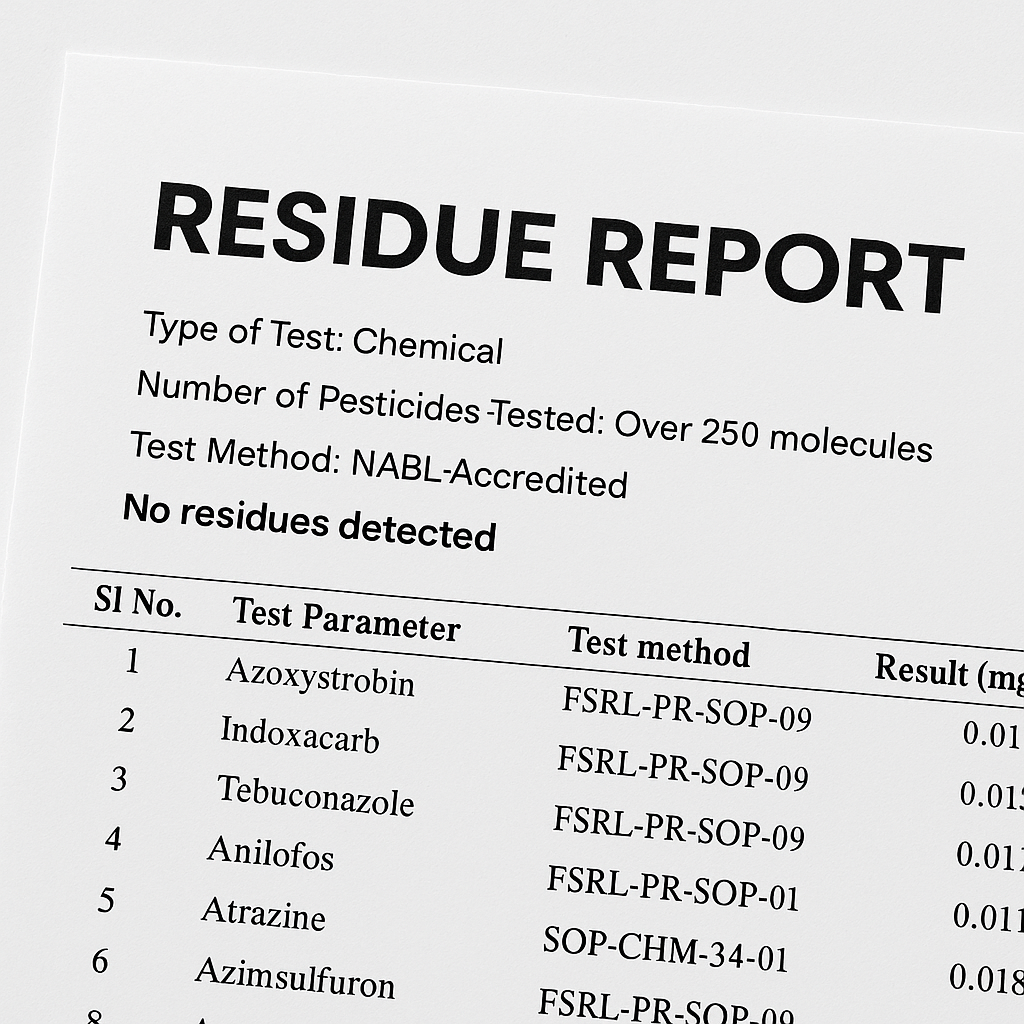
2. Pesticide Residue Testing
Eggs were tested for hundreds of pesticides, including:
Organophosphates
Neonicotinoids
Pyrethroids
Fungicides and herbicides
Older legacy pesticides such as DDT and Endosulfan
Result:
All pesticide residues were Not Detected / Below Quantification Limit.
This indicates clean feed sourcing and low environmental contamination.
3. Microbiological Safety
The eggs were tested for common food-borne pathogens:
Salmonella
E. coli
Listeria monocytogenes
Staphylococcus aureus
Shigella
Result:
All pathogens were Absent.
This confirms that the eggs are microbiologically safe when handled and cooked normally.
4. Heavy Metals
Tests were conducted for:
Lead
Mercury
Arsenic
Cadmium
Result:
All were Below Quantification Limit.
Copper was detected only at normal, nutritionally acceptable levels.
5. Nutritional Profile (Per 100 g)
Protein: ~12.7 g
Fat: ~9.0 g
Energy: ~141 kcal
These values are consistent with good-quality, fresh eggs.